Gaming Earbuds Manufacturer & OEM Project Support
Select gaming earbuds by architecture and verified performance. MAXENTROP supports mobile-gaming Bluetooth projects while clearly separating low-latency Bluetooth modes from dedicated 2.4 GHz dongle and triple-mode solutions.
Mobile and casual gaming
Current catalog platforms are suitable starting points for mobile-entertainment briefs when latency and device behavior are verified.
Measured end-to-end latency
A game-mode label is not enough. Test method, phone, codec and operating mode affect the result.
Do not overclaim platforms
Bluetooth earbuds should not be presented as PlayStation, Xbox or 2.4 GHz solutions unless the matching architecture is supplied.
Match architecture to the buyer brief
Mobile gamers may accept a Bluetooth platform with a dedicated game mode. Competitive PC and console buyers may instead require a USB dongle, dedicated 2.4 GHz radio or wired fallback. These are different products, cost structures and qualification plans.
A useful RFQ states the device ecosystem, target latency, microphone use, battery expectation and whether simultaneous or multi-mode connectivity is required.
- Mobile Bluetooth game mode
- Dedicated 2.4 GHz USB dongle
- Bluetooth plus 2.4 GHz dual mode
- Triple-mode 2.4 GHz, Bluetooth and wired architecture
Verify the full gaming experience
Gaming conversion depends on more than lighting or case design. Buyers should review audio synchronization, microphone clarity, fit over long sessions, control errors, reconnection behavior and battery life in the actual gaming mode.
Claims should be written after sample testing. If a model has RGB or an ENC microphone configuration, describe only the functions supported by the selected version.
- Latency tested with a documented method
- Microphone pickup and background-noise samples
- Device and operating-system compatibility list
- Controls, prompts and reconnection behavior
Gaming earbud project checklist
| Decision point | What the buyer should confirm | Why it matters |
|---|---|---|
| Latency | Measured value, test method, device and active mode | Marketing labels do not establish real synchronization. |
| Connection | Bluetooth version, codec and whether a dongle is included | Architecture determines compatibility and price. |
| Microphones | Quantity, processing route and real call recordings | Microphone count alone does not prove clarity. |
| Ergonomics | Fit, control placement and comfort over longer sessions | Gaming products are used differently from commute earbuds. |
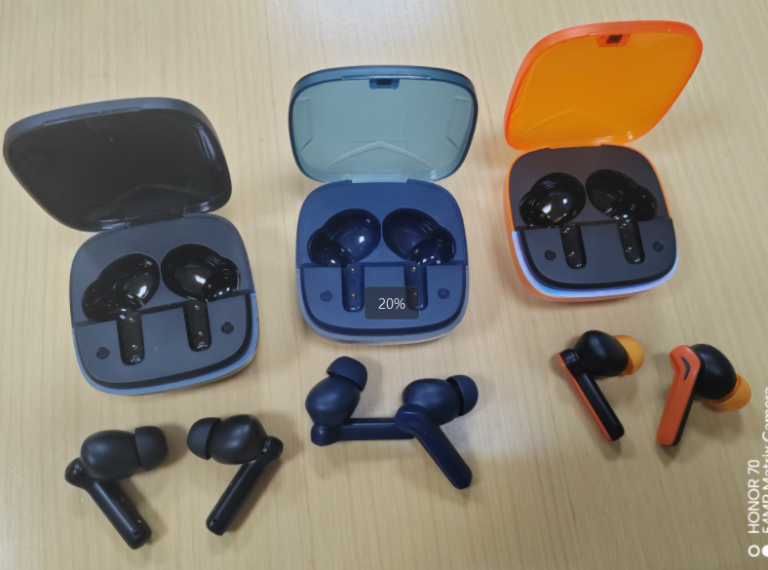
Relevant product platforms
The products below are starting points for discussion. Final specifications, claims, MOQ, documents and production route are confirmed for the selected model.


Questions to resolve before quotation
Are Bluetooth gaming earbuds the same as 2.4 GHz gaming headsets?
No. Bluetooth low-latency modes and dedicated 2.4 GHz dongle solutions are different architectures with different compatibility and latency characteristics.
Which gaming claims need evidence?
Measured end-to-end latency, microphone configuration, codec, supported devices and operating mode should be confirmed on the approved sample.
Send the target gaming platform—not just a product picture
Tell us whether the project is for mobile, PC, console or multi-platform use, together with the required connection modes, quantity, market and branding route.
Direct answers before you request a quote
Are Bluetooth gaming earbuds the same as 2.4 GHz gaming headsets?
No. Bluetooth low-latency modes and dedicated 2.4 GHz dongle solutions are different architectures with different compatibility and latency characteristics.
Which gaming claims need evidence?
Measured end-to-end latency, microphone configuration, codec, supported devices and operating mode should be confirmed on the approved sample.
Reviewed November 2026 by the MAXENTROP editorial team. Product and commercial facts remain subject to model-specific confirmation. Editorial policy · Evidence status